
The body has a built-in cellular repair system that most people will never activate. It runs without supplements, without a gym membership, without a subscription box. It may be one of the reasons a sharp-thinking 75-year-old can look two decades younger than the same-age person two blocks over. The wellness industry has spent the last decade pushing outside-the-cell solutions, when the answer was always inside the cell.
That system has a name. It is autophagy. The science behind it won a Nobel Prize. Most readers have heard the word without knowing what it actually does, when it kicks in, why it slows with age, or how to reliably activate it. The answer to those questions is the most important longevity story of the last decade.
Below is a plain-language walkthrough of autophagy, why aging research has converged on it as the cellular hinge that drives healthspan, what standard activation methods can and cannot deliver, and the one nutrition protocol with direct human evidence of triggering it.
Table of Contents
What Is Autophagy?
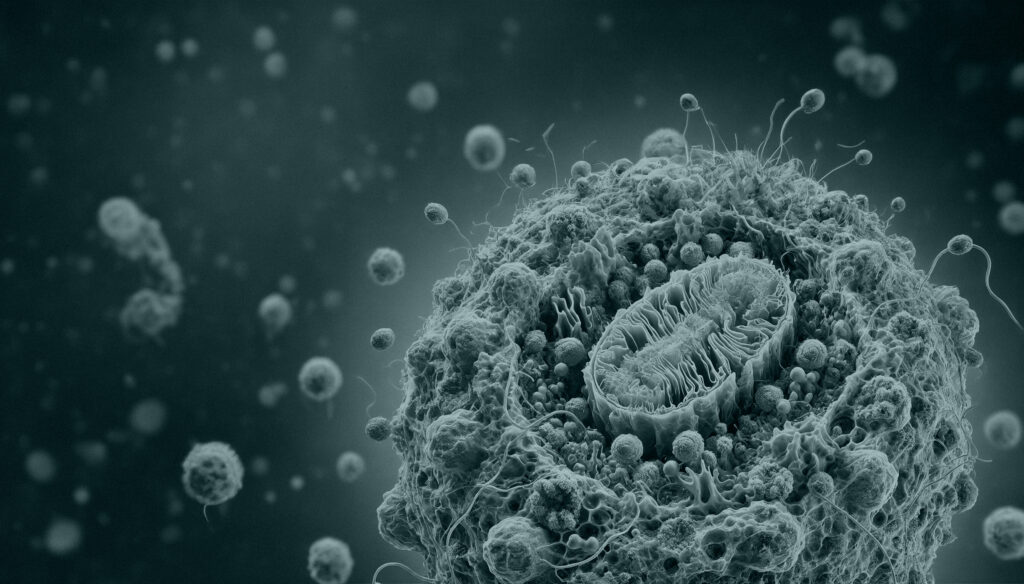
The word comes from Greek. “Auto” means “self.” Phagy means eating. Autophagy is, plainly, the body’s process of “eating” its own damaged parts in a beneficial way. The cell uses it to break down damaged proteins, dysfunctional organelles, and the metabolic debris that accumulates during normal cellular function, then recycles those parts into new cellular machinery.
The discovery of the autophagy mechanism won Yoshinori Ohsumi the 2016 Nobel Prize in Physiology or Medicine. Ohsumi, a Japanese cellular biologist, identified the autophagy-related (ATG) genes by studying baker’s yeast and traced their parallels in human cells. His work mapped the molecular machinery that lets a cell tag, package, and digest its own damaged components, and showed how dysfunctions in those genes contribute to several diseases. The Nobel committee gave him the prize for foundational biology, not a wellness fad.
The cellular function is straightforward. When a cell accumulates damaged proteins or organelles beyond a threshold, autophagy clears them, and the resulting material is recycled into new components. Without regular autophagic cycles, damaged components accumulate in cells over time and contribute to cellular dysfunction that can drive age-related disease. Autophagy is the cellular cleanup crew and the recycling plant in one process, running in every cell of the body.
Why Autophagy Drives How You Age
Autophagy slows down with age. The cellular signals that activate it become less responsive. Damaged proteins clear less efficiently. Dysfunctional mitochondria stay in cells longer. The debris accumulates, and the cellular environment ages from the inside out.
The downstream effects line up with the diseases everyone associates with aging. Neurodegenerative conditions like Alzheimer’s and Parkinson’s are driven in part by the accumulation of misfolded proteins that autophagy could normally clear. Metabolic dysfunction, including insulin resistance and type 2 diabetes, is linked to the buildup of damaged mitochondria. Immune decline tracks with the accumulation of senescent and damaged immune cells. Cancer risk rises when damaged cells survive past the point at which autophagic clearance should have removed them. Biological aging, as measured by blood biomarkers and DNA methylation patterns, accelerates when autophagy slows.
That is the gap between chronological age and biological age. A 50-year-old with high autophagic function likely carries a younger biological age than a 50-year-old with low autophagic function, even with the same calendar age. The longevity research community has spent the last decade trying to figure out how to keep autophagy active across the second half of life, because the cellular evidence keeps pointing to it as the lever that drives healthspan.
How to Trigger Autophagy
Autophagy responds to nutrient scarcity. When the cell senses that fuel is limited, the autophagy program is activated as part of the body’s survival response. Recycling damaged components into new building blocks made evolutionary sense when food was short, and the wiring is preserved across all mammals.
The standard tools for activating it all lean on this. Water fasting is the longest-studied. It strips the fuel input completely, cellular signaling shifts, and recycling proceeds. The problem is sustainability. Whole-body autophagy typically requires roughly 72 hours of nutrient scarcity to activate, and a 72-hour water fast is brutal on the body and the schedule. Most adults cannot run one without compromising work, family commitments, or basic functioning. Muscle wasting becomes a real risk after 48 hours of zero nutrient intake.
Intermittent fasting is the gentler tool, and it has captured the mainstream wellness conversation. The 16:8, alternate-day, and 5:2 protocols all keep enough nutritional load in the diet that practitioners can keep working and exercising. However, the position Prolon and L-Nutra take, which is grounded in the underlying science, is that intermittent fasting does not trigger autophagy. Whole-body autophagy activation requires roughly 72 hours of prolonged fasting, and the IF windows commonly practiced (16, 24, or 36 hours) do not reach that threshold. IF can deliver other metabolic benefits, but the cellular renewal process autophagy describes does not switch on inside those windows.
Traditional calorie restriction, in which daily intake is reduced by 20-40%, can also activate autophagy. But the protocol has to be maintained for 15 days to several months to produce meaningful sustained benefits, which puts it out of reach for most people who are not already deeply disciplined about food. High-intensity exercise can nudge autophagy, too, but the effect stays localized to muscle tissue and lasts only in short bursts, rather than producing the sustained whole-body activation the longevity outcomes need.
That left a clear gap. Until recently, no reliable nutritional protocol existed that could activate deep, whole-body autophagy across a controlled window, without the misery of a multi-day water fast, the inconsistency of intermittent fasting, the months-long discipline of calorie restriction, or the localized window of exercise-induced activation. People who wanted serious cellular work had no rigorous path.
The Breakthrough
The gap closed when the Fasting-Mimicking Diet (FMD) was developed at the University of Southern California’s Longevity Institute. The FMD is a 5-day nutrition protocol designed by Dr. Valter Longo, the director of the Longevity Institute at USC and the Longevity and Cancer Program at IFOM Milan. Dr. Longo and his team built the protocol after years of studying which macronutrient and micronutrient ratios could keep the body in a biological fasting state at the cellular level while still allowing structured food intake.
The result is Prolon, the productized 5-day FMD. The cellular signals during the protocol match those produced by the body during a deep-water fast. Studies have shown that insulin, glucose, and IGF-1 can drop, ketones rise, and that autophagy machinery activates. But the user is eating, working, and moving through their normal life on a structured nutrient intake that can prevent the muscle wasting and cognitive cliff of a true water fast. A 2022 randomized trial in the European Journal of Applied Physiology (Nardon et al., PMID 35034194) compared three FMD cycles with a normal-diet control in 24 physically active men, with no detrimental changes in muscle volume or force production observed across the protocol.
The direct human evidence on autophagy activation emerged from a 2025 trial led by Cedars-Sinai Medical Center and UT Health San Antonio (NCT06115551), in collaboration with L-Nutra. Thirty healthy adults between 25 and 65 (roughly 80% female and 80% Hispanic or Latino) were randomized into three arms: original Prolon, a modified low-starch formulation, and a normal-diet control. Researchers used molecular assays typically reserved for pharmaceutical research to measure autophagic flux directly in immune cells, tracking the full cycle of how cells form and break down the small membrane sacs called autophagosomes.
The Prolon group showed clear molecular signs of autophagy activation by Day 6. The modified-formula arm showed similar shifts. The control group did not. The Cedars-Sinai principal investigator, Dr. Sara Espinoza, described the trial as one of the first to track autophagy in humans as a real-time process during a nutrition program. Prolon FMD is the first and only nutrition program clinically proven to trigger autophagy directly in humans.
After 3 Rounds
A single 5-day cycle of Prolon can deliver measurable cellular work. Autophagy activates, ketones rise, insulin drops, and the metabolic markers may shift. The Cedars-Sinai trial recorded an average weight loss of 1.7 kg (about 3.75 pounds) across a single cycle, with fasting glucose dropping by 12 to 14 mg/dL and HOMA-IR scores falling accordingly.
A single cycle activates autophagy, as the Cedars-Sinai trial confirmed at Day 6. The deeper long-form outcomes, like the biological age reduction, the immune support-age shift, and sustained skin hydration, are tied to three consecutive monthly cycles.
A 2024 paper in Nature Communications pooled data from two independent randomized clinical trials of the FMD and found that three cycles reduced median biological age by 2.6 years across 86 completers. The biological age measure is the KDM (Klemera-Doubal) clinical chemistry score, based on seven multi-system biomarkers: albumin, alkaline phosphatase, creatinine, C-reactive protein, HbA1c, systolic blood pressure, and total cholesterol. The reduction was independent of weight loss. Subjects who didn’t lose weight still saw the biological age decrease. Worth knowing, honestly, the paper also reported non-responders: 21 to 31% of participants across the two trials showed an increase in biological age across the protocol. The intervention works for most but not everyone, and individual physiology shapes the response.
The other long-form outcomes follow the same three-round arc. The Nature Communications MRI subset showed significant reductions in visceral adipose tissue after three cycles, with hepatic fat dropping nearly 50% in participants with baseline hepatic steatosis. The lymphoid-to-myeloid ratio, an immune-age signal that shifts toward a more youthful pattern when the immune system rebalances, rose significantly in FMD completers while staying flat in controls.
A 2023 randomized controlled trial in the Journal of Clinical Medicine (Maloh et al., PMC10003066) administered FMD to 45 healthy women aged 35 to 60 over 71 days, across three consecutive monthly cycles. At Day 11, five days after completing the first cycle, the FMD group’s skin hydration was 25.1% above baseline, compared with 8.52% in the control group. Skin hydration in the treatment group remained significantly elevated at Day 71 (p=0.02) after the third cycle wrapped, while the control group’s skin roughness increased significantly over the same window. Cellular renewal becomes visible from the outside, and the sustained signal at Day 71 is what distinguishes three rounds from a single cycle.
Three rounds are the protocol that the data validates.
How to Do It
The suggested onboarding is straightforward. Five days, once a month, for three consecutive months, followed by three to four cycles yearly. Each day’s food is pre-portioned in a structured kit that walks the user through breakfast, lunch, an afternoon snack, dinner, and supplements. The kit rotates through nut-based bars, vegetable soups, kale crackers, olives, herbal teas, an NR-1 vegetable powder capsule with vitamins and minerals, a chocolate crisp bar, and an L-Drink (a glycerol-based hydration drink that helps protect muscle mass and maintain energy and electrolyte balance during the fast) across the five days, with portions and macronutrient ratios calibrated to keep the body in the fasting state at the cellular level while still tasting like food.
Day 1 is the highest-calorie day of the protocol. Insulin and glucose start dropping by evening. Day 2 carries a shift into mild nutritional ketosis as the body switches to fat as its primary fuel source. Days 3 and 4 are the deepest part of the protocol, with ketones rising and autophagy ramping up. Day 5 carries deep cellular renewal, with the benefits of autophagy shown to carry over into Days 6 and 7. Most users report a noticeable energy and clarity shift across Days 3 to 5 once the body fully adapts to the fasting state.
The transition day after the protocol returns the body to normal eating, and the recommendation is to wait roughly three to four weeks before starting the next cycle, which lines up with the monthly cadence the clinical studies tested. After the first three consecutive cycles, the recommendation is only three to four times a year for maintenance.
Anyone considering the protocol with a chronic health condition should consult a physician before starting. The brand publishes contraindications openly. Pregnancy, breastfeeding, BMI below 18, Type 1 or insulin-dependent Type 2 diabetes, eating disorder history, active cancer treatment, kidney or liver disease, and dialysis are all conditions the protocol is not designed for. For anyone with one of those conditions, the metabolic shifts during the protocol can interact with medication and physiology in ways that need clinical oversight. Consulting with a healthcare provider before the first round is the standard safety step.
The Verdict

Autophagy is real, foundational, and Nobel Prize-recognized. The body’s most rigorously studied cellular renewal process is also the most under-activated longevity lever in modern life, because every standard activation tool has carried real-world friction. Water fasting is impractical past 48 hours. Intermittent fasting produces inconsistent activation. Calorie restriction demands months of discipline. Exercise-induced autophagy stays localized to muscle tissue.
Prolon is the only nutrition program with direct human evidence of autophagy activation. The 2025 Cedars-Sinai and UT Health San Antonio trial measured autophagic flux directly in immune cells and confirmed the response by Day 6 of the Prolon cycle. The three-round protocol is the version that the long-form clinical data validates. The 2.56-year reduction in biological age (KDM clinical-chemistry clock), visceral fat reduction, and sustained skin hydration are the cellular outcomes observed across participants who completed three consecutive monthly cycles.
A single round activates the process, and results in benefits like support for metabolic health, fat loss, muscle protection, and increased energy, but three rounds can compound it. For readers who have been looking for a serious way to act on the longevity science they have been reading about, the 3-round subscribe-and-save bundle is the protocol that the clinical data supports.




Ask the community or leave a comment
WRITE A REVIEWCustomer Reviews
Leave a review