Pair Eyewear vs. Zenni and Warby Parker: Which Clip-On System Does More for One Pair of Glasses?

Wearing prescription glasses used to mean picking a side. See clearly, or wear sunglasses. Clip-ons were settled a long time ago, and most of the big online eyewear brands now sell some version of them.
What none of them agree on is the attachment’s purpose. For most brands, it’s a sun lens, and the job ends there. For one of them, it’s the front of the glasses, and the sun is a single line inside something much larger.
Three brands, three answers to the same problem. Here’s how Pair Eyewear, Zenni Optical, and Warby Parker compare across the five things worth checking before you buy.
Table of Contents
About Pair Eyewear
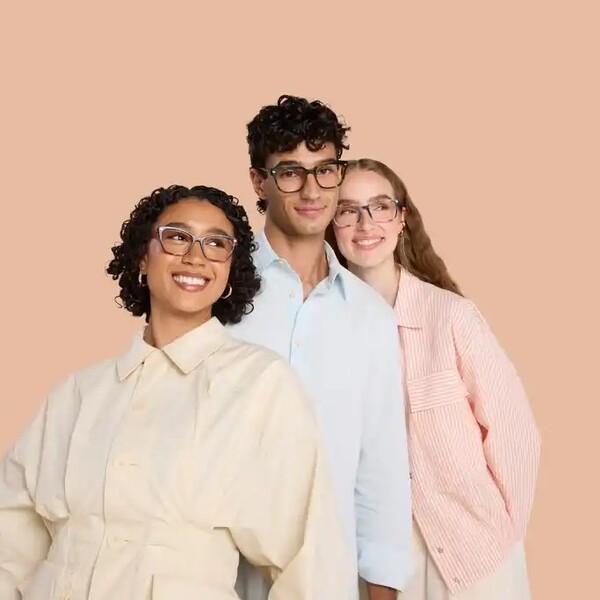
Pair started with a founder who’d worn glasses since he was eight and was bored with the same face in the mirror every morning. The company’s answer was to split a pair of glasses in two.
The first half is the base frame, which carries the prescription and stays put. Standard acetate frames run $85, the newer Forte collection $110, and metal frames $130. Single-vision lenses, readers, and non-prescription lenses are all included at no extra charge, and Pair makes every lens in its own Lens Lab.
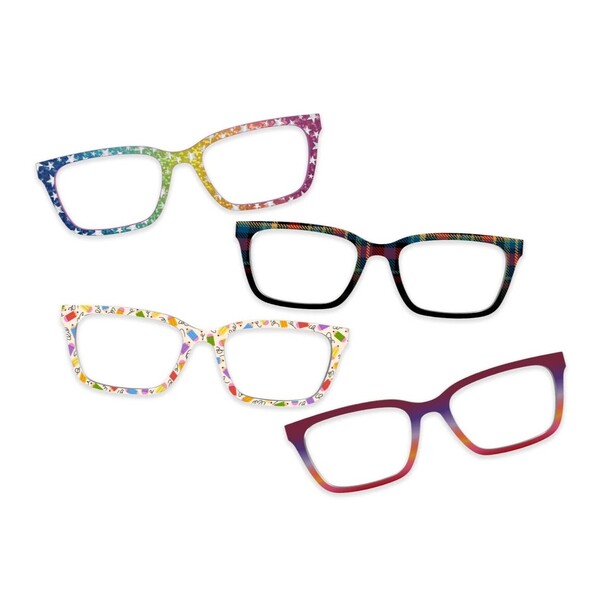
The second half is the top frame, which most people call a topper. Two magnets, each weighing under a gram, hold a new front over the base frame, and the system is patented. Toppers start at $25, Sun Tops are $35, and Sparkle Sun Tops are $40. The catalogue sorts into florals, geometrics, plaids, stripes, tortoise, animal skins, sparkles and shimmers, gradients, ombre and marble, alongside seasonal drops and licensed collections from Disney, Marvel, Star Wars, Harry Potter, Pokémon, MLB, and NHL.
About Zenni Optical
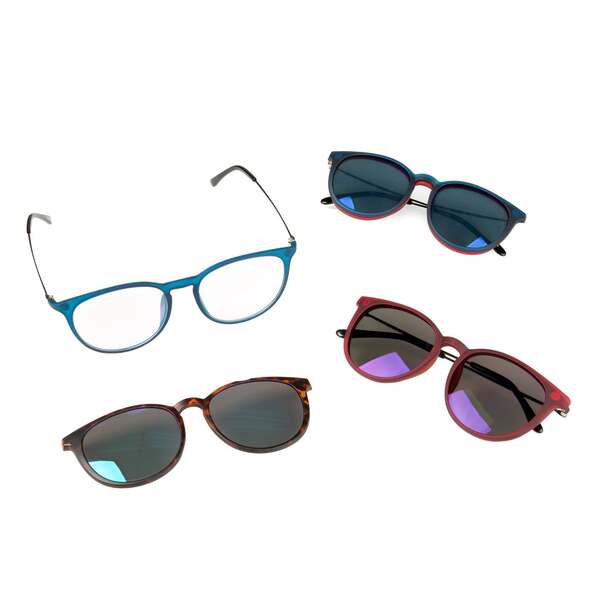
Zenni sells prescription eyewear directly and built its catalogue around the complete pair rather than the frame alone.
Its clip-on offering comes in two forms. Magnetic Snap-On Sets use magnets built into a specific Zenni frame, and there are 32 in the catalogue. Clip-On Sets, also sold as Quick Clips, use a metal clip that slips over the frame, and there are 81 of those. Both are sold as complete sets, so the listed price covers the frame, basic prescription lenses, anti-scratch coating, UV protection, and the attachment itself.
Compatibility runs frame by frame. Zenni states that clip-ons aren’t available for every style, and the site has a Clip-On Finder where you enter a frame number to check. The attachments are organized by shape and color, through rectangles, ovals, browlines, aviators, and cat-eyes, in greys, silvers, blacks, and tortoise.
About Warby Parker

Warby Parker sells prescription eyewear direct to customers. Eyeglasses start at $95 with prescription lenses, scratch-resistant coating, and anti-reflective coating included, and progressives start at $295.
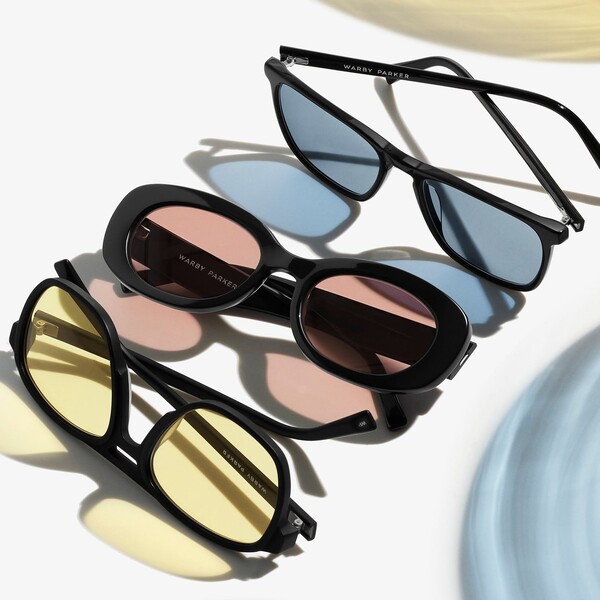
Clip-Ons are a separate accessory at $75, the same price across every style. There are 18 of them, named after and cut to the frames they fit, so a Durand Clip-On Medium fits a Durand Medium and nothing else. They come in Medium or Wide, in Polished Silver, Polished Gold, Brushed Ink or Antique Silver, with lenses in grey, green, blue, or brown.
The attachment is a stainless steel mechanical clip rather than a magnetic one, and it ships with a carry pouch.
What to Consider?
All three of these sit on the front of glasses you already paid for. So the decision turns on how the attachment holds on, what it changes once it’s there, and what it costs to get a second one. Those three questions pull further apart than the category suggests, because these brands are not selling the same product.
1. How the Attachment Holds On
Attachment settles two things at once. Does it stay put, and what’s happening to the prescription lenses underneath after a few hundred swaps?
Pair Eyewear
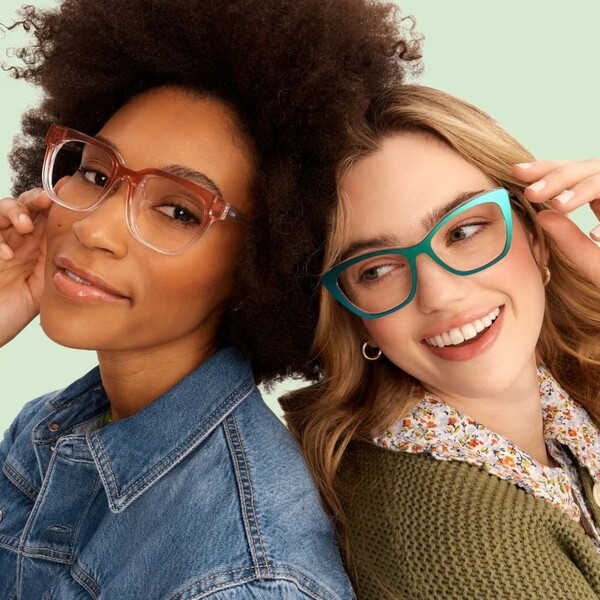
Two magnets hold the Topper at the upper corners of the Base Frame, and the mechanism is patented. Nothing clamps, grips, or rests on the lens. The Topper replaces the visible front of the frame rather than sitting over it, so the finished glasses read as a single object rather than a frame with something attached.
Zenni Optical

Zenni runs two mechanisms depending on the frame. Magnetic Snap-On Sets connect with magnets built into that specific frame, while Clip-On Sets use a metal clip that slips over the front. Either way, the attachment sits on top of the finished frame, and Zenni notes that clip-ons aren’t available for every style in the catalogue.
Warby Parker

Warby Parker’s Clip-Ons are mechanical. The company makes no magnetic claim anywhere on its site, and the product pages describe a stainless steel clip. Each one is cut to a specific frame size, so it fits precisely and stops being useful the moment that frame leaves the house.
Verdict
Pair takes this on the mechanism. A patented magnetic front that replaces the face of the frame keeps hardware off your prescription lenses entirely, which neither an overlay clip nor a snap-on can claim, and it works across the whole Base Frame range rather than on a compatibility list.
2. How Many Ways One Pair Can Look
Once the attachment stays on, the question is what actually shows up on the front of your glasses. That decides how often anyone uses the thing.
Pair Eyewear
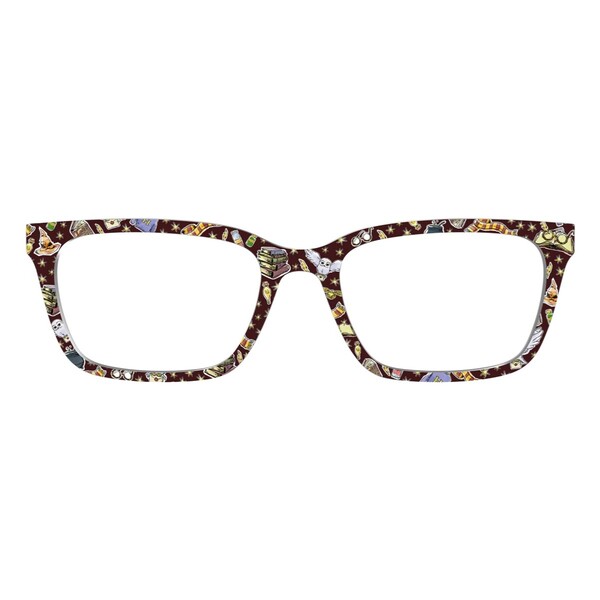
Sun is one product line among many. The Topper catalogue runs past 1,800 designs across florals, geometrics, plaids, stripes, tortoise, animal skins, sparkles and shimmers, gradients, ombre, and marble. On top of that, there are seasonal drops and licensed collections from Disney, Marvel, Star Wars, Harry Potter, Pokémon, MLB, and NHL. A Van Gogh print on Tuesday, a Sun Top for the drive home, and the same two magnets.
Zenni Optical
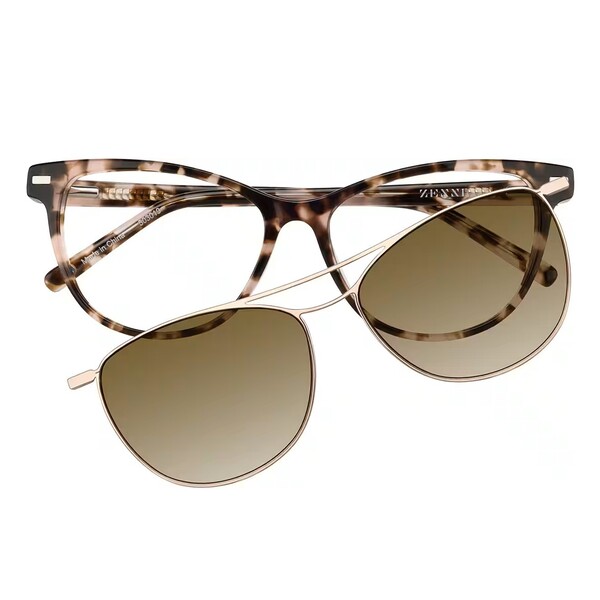
Zenni’s attachments change the tint. The 32 magnetic sets and 81 clip-on sets are organized by frame shape and lens color, running through greys, silvers, blacks, and tortoise. Nothing in the catalogue is patterned or decorative.
Warby Parker
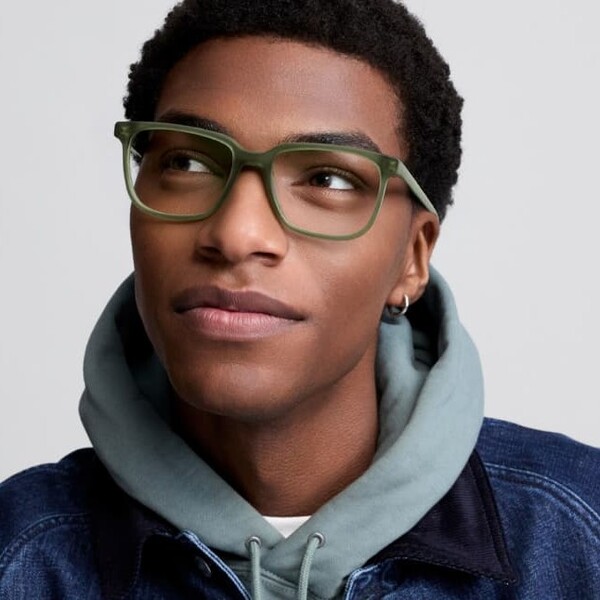
Four lens colors: grey, green, blue, and brown, in four metal finishes. The 18 styles differ by which frame they fit rather than by how they look, and there’s no decorative or patterned option at any price.
Verdict
Pair wins this outright, and the margin is the story. More than 1,800 designs against zero decorative fronts at either competitor isn’t a close contest; it’s a different product category. Neither Zenni nor Warby Parker sells a single patterned front.
3. What a Second Look Costs
All three are priced per piece, but what most buyers actually want is variety. The fair measure is what each additional look costs once the glasses are paid for.
Pair Eyewear

An $85 base frame with lenses included, plus four toppers at $25, comes to around $185 for one prescription pair that shows up in five different ways. Every look after that is $25, or $35 for a sun top. Pair currently offers a free Topper on orders over $200 with code FREETOP, which aligns neatly with exactly that kind of order.
Zenni Optical

A complete set includes the frame, basic prescription lenses, and the attachment, at $19.95 to $40.95. What the attachment changes is the tint, so wanting glasses that look different means buying another pair of glasses rather than another front.
Warby Parker

A frame at $95 plus a clip at $75 comes to $170. A second clip is another $75 and produces a different lens tint rather than a different pair of glasses, and it only fits the one frame it was cut for.
Verdict
Pair wins this decisively, and the reason is structural. Five distinct pairs of glasses for around $185 is a number neither competitor can approach, because a second look at Warby Parker costs $75 and still isn’t a second look, and at Zenni, it means another pair of glasses entirely.
4. Prescription Lenses and Upgrade Options
Underneath all of this sits a prescription, and how a brand treats it says whether they’re selling glasses or selling an accessory.
Pair Eyewear

Pair makes every lens in its own Lens Lab. Single-vision, readers, and non-prescription all come at no upcharge to the base frame price. The upgrade menu is the deepest of the three: FluidFocus progressives at $199; 1.59-index at $39; premium 1.67 high-index at $59; BlueBarrier blue-light filtering at $49; advanced anti-reflective at $25; and SolarSense light-responsive lenses at $149. FSA and HSA funds are accepted.
Zenni Optical

Basic prescription lenses are included in the set price, along with anti-scratch coating and UV protection. The lens menu attached to the clip-on range stops there, with no progressive, light-responsive, or anti-fatigue option carried through to it.
Warby Parker

Prescription lenses are included in the $95 starting price with scratch-resistant and anti-reflective coatings applied. Progressives are the outlier at $295, roughly $100 more than Pair charges for the same upgrade.
Verdict
Pair takes this on range and on price. Progressives at $199 undercut Warby Parker’s $295 by nearly $100; the blue-light, high-index, and light-responsive options have no equivalent attached to either competitor’s clip-on line, and every lens is made in-house rather than bought in. Running the whole order through FSA or HSA funds settles it.
5. What Works for Kids
Children break glasses, lose glasses, and refuse to wear glasses they don’t like. So a system built around swapping fronts has an obvious use here, and it’s worth asking what each brand actually offers.
Pair Eyewear

Pair runs a kids collection of Base Frames alongside the adult range, and every Topper in the catalogue fits the same magnetic system. That includes the licensed lines, so a child picks Pokémon for school and Marvel at the weekend without a second pair of glasses existing anywhere in the house.
Zenni Optical

Zenni’s clip-on range is organized around adult frame shapes and sunglass tints. There’s no decorative or character option attached to it.
Warby Parker

The Clip-On range is four lens colors across 18 adult frames. Nothing in it is aimed at children, and a $75 accessory cut to one frame is an expensive thing to hand a seven-year-old.
Verdict
Pair wins this by default, because neither competitor is competing. A child choosing between Pokémon and Marvel every morning is a completely different proposition from a grey tint, and it’s the one part of this comparison where the alternative to Pair isn’t a cheaper option but no option.
Pair Eyewear vs. Zenni vs. Warby Parker: What Do Customers Think?
Pair Eyewear

Pair publishes review counts on individual product pages, and the volume is striking. The Larkin base frame alone carries 10,830 reviews, and the company reports more than 200,000 five-star reviews across the site. For a brand younger than both competitors, that’s a lot of accumulated feedback sitting on a single frame.
Zenni Optical

Zenni also shows counts per product, ranging from 99 to 130 reviews for the magnetic snap-on sets we checked. Reasonable for one frame in one color, and a long way short of the volume a single Pair frame attracts.
Warby Parker

Warby Parker doesn’t display review counts on its clip-on product pages at all, so there’s no published figure to weigh.
Pair Eyewear vs. Zenni vs. Warby Parker: Promotions and Discounts
Anyone buying an interchangeable front is likely to buy a second one, so what a brand does about the repeat order matters as much as the first sticker price.
Pair Eyewear
- Free Topper on orders over $200 with code FREETOP
- Free shipping on all US and Canada orders, no minimum
- Pair+ membership, 15% off every order
- Topper sets are priced up to 15% below buying the same toppers singly
- Framed Finds clearance, up to 30% off
- FSA and HSA funds accepted
Zenni Optical
- Free shipping over $65
- Set pricing that bundles frame, lenses, coatings, and attachment into one figure
Warby Parker

- No published clip-on discount structure of any kind, with the $75 price flat across all 18 styles
Verdict
Pair takes this on structure rather than on the size of any single discount. A membership, bundle pricing, a clearance shelf, and a gift threshold all reward the second and third orders, which suits a product built to be bought more than once. Warby Parker’s flat $75 leaves nothing to compound.
Pair Eyewear vs. Zenni vs. Warby Parker: Shipping and Returns
Pair Eyewear

Free standard shipping to any US or Canada address with no minimum spend, and expedited options from $15 for anyone who needs a pair sooner. Returns are available for a full 30 days from purchase, with a choice of box-free drop-off or a prepaid mail label.
Zenni Optical
Standard shipping is $4.95, free over $65. Returns are the tightest here: 14 days from delivery for a refund, or 30 days for store credit, and shipping charges aren’t refunded under any circumstances.
Warby Parker
Free shipping and free returns within 30 days. The clip-on is an accessory bought separately from the frame, so it travels and returns on its own terms rather than as part of the glasses.
Verdict
Pair takes this on coverage. Free shipping with no minimum, a full 30-day window, and a single policy covering the base frame, the lenses, and every topper in one order is a cleaner promise than an accessory returning separately, and Zenni is the outlier with a 14-day refund window and shipping charges; it never refunds.
Who Will You Shop With?

Pair Eyewear is answering a different question from either of the others, and that’s what the comparison comes down to. Zenni and Warby Parker both sell a sun lens that goes over your glasses, and that’s where the job ends. Pair sells the front of the glasses in more than 1,800 designs, with the sun as a single line inside.
The gap shows up hardest in what a second look costs. At Warby Parker, it’s another $75 for a mechanical clip cut to a single frame in one of four lens colors. At Zenni, it means buying another pair of glasses. At Pair, it’s $25, the magnets stay where they are, and the glasses genuinely look like different glasses.
The rest follows from that. Two magnets under a gram keep hardware off your prescription lenses instead of clamping onto them. Lenses come included from $85 and are made in Pair’s own Lens Lab, with progressives a hundred dollars under Warby Parker’s. One policy covers the frame, the lenses, and every Topper in the same order, and the whole thing is paid for through FSA or HSA funds.
Nobody else in this comparison sells a single patterned or decorative front at any price, and nobody else has anything to hand a child who wants Pokémon on Monday and Marvel on Saturday. So the real choice isn’t which clip-on is best. It’s whether you want your glasses to look the same every day, and if the answer is no, there’s currently one company selling the alternative.
Explore your options for eyewear with these top brands:


Ask the community or leave a comment
WRITE A REVIEWCustomer Reviews
Leave a review