Lojel vs Monos: Which Hard-Shell Suitcase Is Worth Buying?

Hard-shell luggage has converged. Polycarbonate shells, spinner wheels, TSA locks, and a telescoping handle are now table stakes, and two suitcases sitting side by side in an airport look close enough that the choice can feel like picking a color.
The differences show up later. They show up in a hotel room too small to open a case on the floor, at a check-in desk when the bag comes back three kilos over, and eighteen months in, when something breaks, and a warranty page decides who pays.
Lojel and Monos both sell directly, both build in polycarbonate, and both are Certified B Corporations. What follows is how the Lojel Cubo and the Monos hard-shell line compare across six factors that determine how a suitcase performs over years rather than days.
Table of Contents
About Lojel

Lojel was founded in Japan in 1989 by Chih Chang Chiang, who took his bag designs to Toyama and set up a manufacturing partnership there. Those same partner factories in China and Indonesia still produce the line, and the founder’s grandson, An Chieh Chiang, runs the company today from Hong Kong with offices across Asia, North America, and Europe.
The name is an acronym for Let Our Journeys Enrich Life. The design philosophy is organized into three headings that the brand publishes openly. “Less, but better,” which it defines as designing only what’s necessary. “Simply User-Centric,” with a promise not to distract with complicated bells and whistles. And “Modern Movement,” built on the idea that movement isn’t limited to travel.
Lojel is a Certified B Corporation, holds Climate Label certification, and sources leather components through Leather Working Group-certified suppliers. The published sustainability figures carry numbers rather than intentions: 45,213 suitcases repaired since 2023, 83,523 kg of waste diverted through those repairs, 441 pieces of luggage donated, and packaging that reached 99.6% natural materials in 2025 against a 100% pledge for 2026.
The Cubo is the line the brand is best known for, built around a flat-top opening rather than a clamshell, with six sizes running from a 29-liter carry-on to a 146-liter check-in.
About Monos
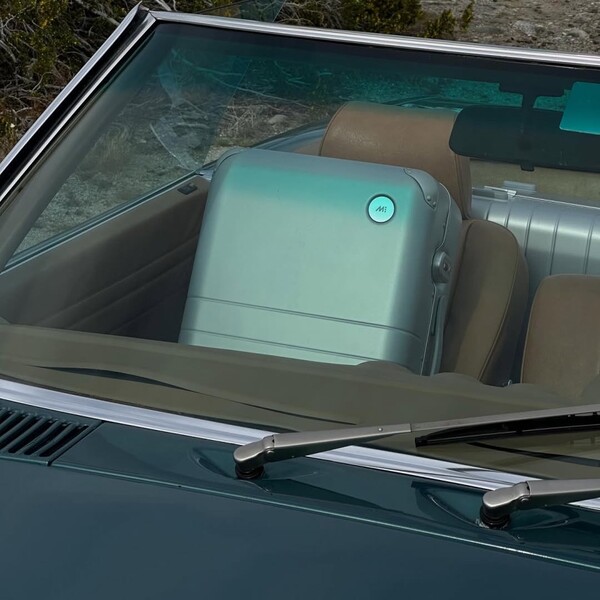
Monos was founded in 2018 by three founders who publish only their first names, Victor, Daniel, and Hubert, and designs its products at a studio in Vancouver, Canada. The company describes itself as a Canadian travel and lifestyle brand.
The name comes from the Japanese concept of mono no aware, which Monos glosses on its own site as “the profound appreciation of the beauty in fleeting moments.” The taglines it uses are “Travel mindfully,” “Less is more,” “Made to last,” “Accessibly priced,” and “People before profits.”
Monos became a Certified B Corporation in early 2025 with a score of 84.5, claiming it was the first North American luggage brand to do so. It partners with Climate Neutral on carbon offsetting, belongs to 1% for the Planet, and runs a reforestation partnership with Veritree in Kenya’s Old Bonjoge Forest.
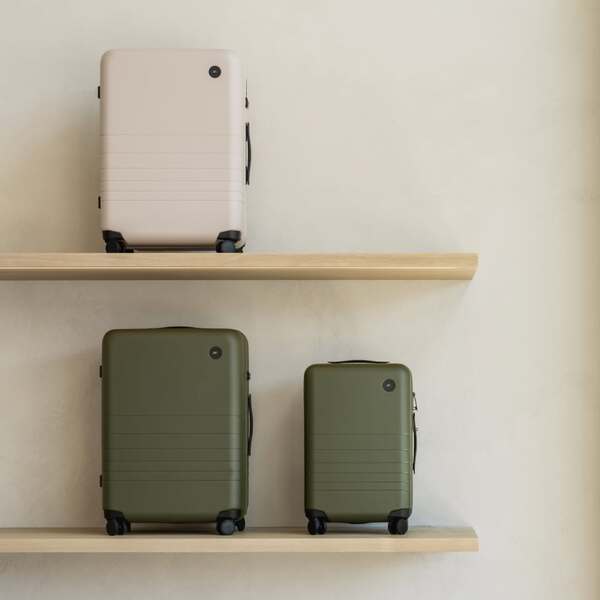
The hard-shell range covers a Carry-On, a Carry-On Plus, a Check-In Medium, and a Check-In Large, in fourteen colors, with a separate Expandable line alongside it.
What to Consider
Both brands make polycarbonate cases at similar prices, ship direct, and carry certifications that hold up. So the decision comes down to the things that only surface after the purchase.
Six of them separate these two.
1. How the Suitcase Opens
The opening design decides where a suitcase can be packed. A case that has to lie flat needs floor space equal to twice its footprint, which is easy in a bedroom and difficult in a hotel room, a hostel, a train compartment, or the back of a car. Worth weighing for anyone who packs and repacks mid-trip rather than once at each end.
Lojel
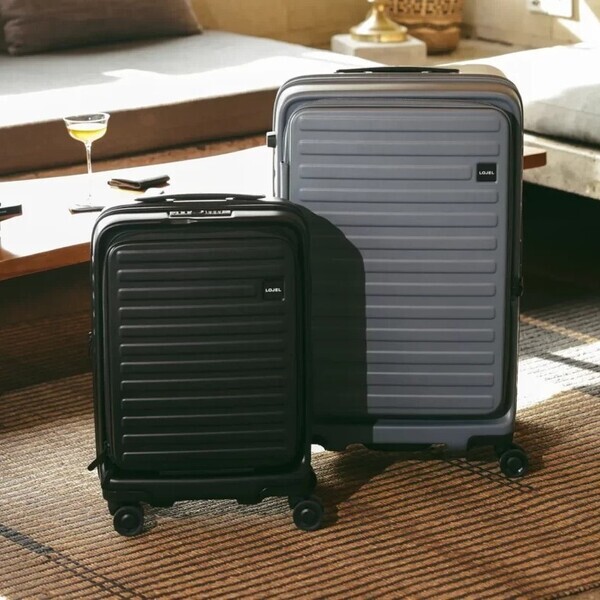
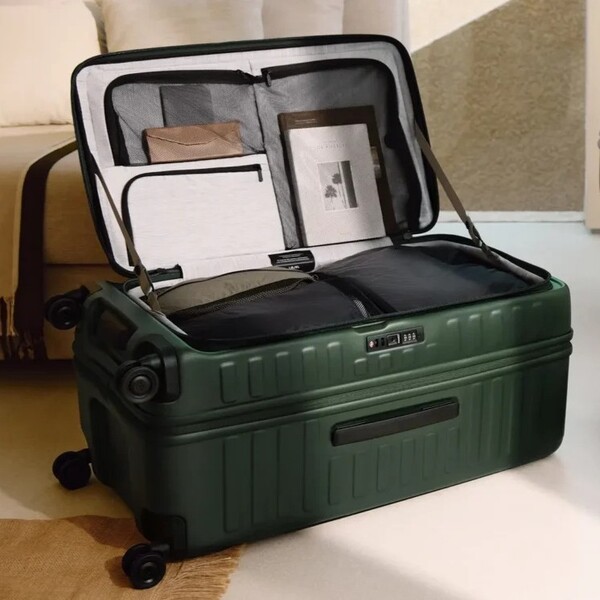
The Cubo uses a flat-top opening, which Lojel describes as allowing “easy and convenient access, even in tight spaces, ensuring you can pack or unpack virtually anywhere during your journey.” The lid lifts from the top like a trunk, so the case stays upright against a wall or on a luggage rack.
Both carry-on sizes add a front compartment for a laptop, chargers, and documents, reached through a magnetic quick-access flap without opening the main case at all.
Monos
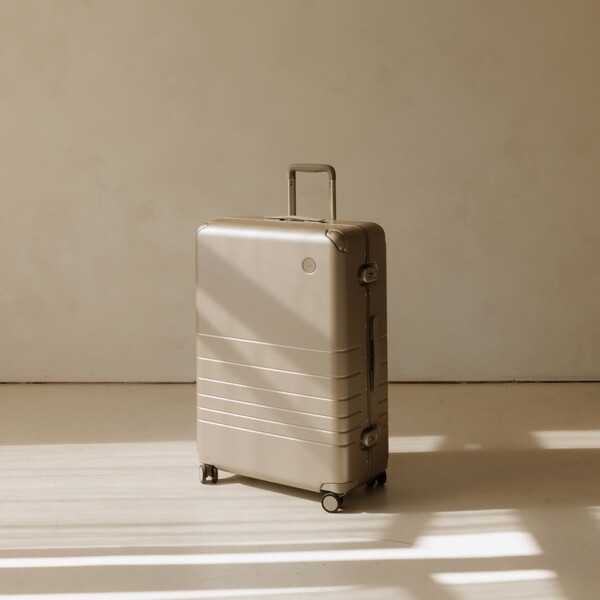
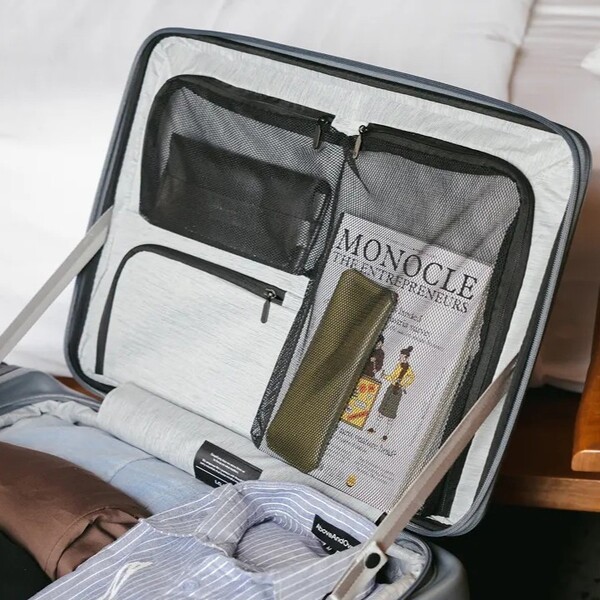
Monos describes the Check-In Medium as having “a zipped panel on one half of the suitcase” for shoes, with “ballistic nylon compression straps and a cover panel with pockets” holding clothing on the other half. The carry-on sizes include a removable compression pad with a zippered pocket.
Verdict
Access goes to Lojel, and the gap is structural rather than a matter of degree. A top-opening case can be packed in places a two-half design physically cannot, and Lojel built the whole line around that rather than offering it as a variant. The front laptop compartment on the carry-ons compounds it, since the most frequent opening on any trip is at security, and the Cubo addresses that without opening the main compartment.
2. Expansion
Expansion is what a suitcase does on the way home. Almost nobody packs a return trip lighter, and a case that gains depth is the difference between fitting the extras in and buying a second bag at the airport. Worth checking whether it comes as standard or as a paid upgrade.
Lojel
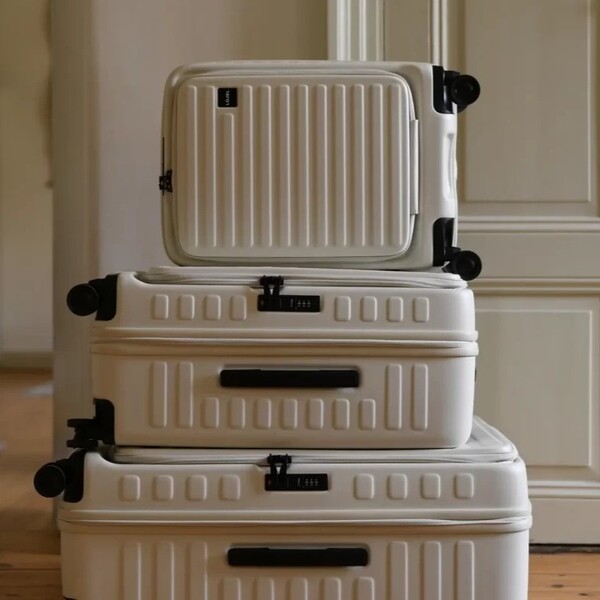
All six Cubo sizes expand. The gain is roughly 3 cm of depth, which works out at 29 to 35 liters on the Small Lite, 37 to 42 on the Small, 74 to 83 on the Medium, 89 to 101 on the Fit Lite, 106 to 116 on the Fit, and 133 to 146 on the Large.
Lojel builds the gusset from thick material rather than a thin panel, and owners who have used it on long trips describe it holding under load.
Monos

The Carry-On, Carry-On Plus, Check-In Medium, and Check-In Large each publish one capacity and one set of dimensions, with no expansion figure. Expansion is sold as a separate line, the Expandable Carry-On, Expandable Carry-On Pro, and Expandable Check-In Medium, which add 1.6 inches of depth through a wraparound zipper and a 1260D nylon gusset.
The Expandable line lists at $325 to $395, comes in four colors rather than fourteen, and has no Check-In Large option. The Expandable Carry-On weighs 7.80 pounds, compared to the standard Carry-On’s 6.60 pounds.
Verdict
A clear one for Lojel, because the comparison isn’t feature-for-feature but standard-for-surcharge. All six Cubo sizes expand at the listed price, in all their colors. To match that at Monos, a buyer moves to a different line that costs $50 more per size, offers four colors, carries a weight penalty, and stops before the largest size exists. For a buyer who wants a large expandable check-in, Lojel is the only one of the two that sells one.
3. What the Warranty Actually Covers
Warranty length is the number brands advertise. Coverage is the part that matters, because a suitcase fails in specific, predictable ways, and the useful question is whether those particular failures are in or out. Worth reading the exclusions rather than the headline.
Lojel
Ten years, global, on every Cubo. The first year is what Lojel calls Hassle-Free coverage, spanning wheels, handles, zippers, trolleys, TSA locks, latches, interior straps, and side bumpers.
Years two through ten cover manufacturing defects, with handle hydrolysis, wheel hydrolysis, wheel detachment, and missing expansion zipper pullers named explicitly. Claims are processed with proof of purchase or a free myLOJEL registration against the serial number.
Monos
A limited lifetime warranty covering “broken or malfunctioning wheels, handles, or telescopic handles that stop performing as intended, and locks that no longer function as designed.”
Airline damage and zipper damage are excluded. Both are headline inclusions of a paid upgrade called Lifetime Warranty+, priced at $35 for the Essential tier or $65 for Pro, which must be purchased within 14 days of delivery. Non-luggage items, including bags and packing cubes, are meant to be carried for two years rather than a lifetime.
Verdict
The exclusions settle this one, not the length. Zippers are included in Lojel’s first-year coverage as standard, and airline handling is the single most common cause of damage to a checked bag. A lifetime warranty that excludes both, then sells them back within a fourteen-day window, and asks the buyer to pay twice for the failures most likely to happen. Ten years that covers the zipper from day one is the stronger promise, and it costs nothing extra.
4. Returns and Trial Terms
A trial period is only as good as what it permits. The question isn’t how many days a brand offers but whether the bag can actually be used during them, and who pays to send it back. Worth reading the conditions, since this is where the two brands’ published terms diverge most.
Lojel

Thirty days, with the item unused and in original condition. Lojel supplies a prepaid return label, so return shipping costs the buyer nothing, and the policy is advertised alongside free shipping as a permanent term rather than a promotion.
Monos
One hundred days, with conditions published in the FAQ. The luggage “needs to stay in brand new, unused condition,” and Monos states that “the 100-day trial is for you to try it at home.”
The trial “will be voided if the suitcase shows signs of use in transit or is returned in unsaleable condition. “A $25 return shipping fee is deducted from the refund.
Verdict
Read both policies as return windows rather than trials, and the Cubo comes out ahead. Both brands require an unused bag, so the practical difference isn’t the number of days. What separates them is that Lojel offers 30 days and charges nothing, while a 100-day trial that cannot survive a trip and costs $25 to exercise is a shorter offer than it sounds. A traveler comparing the two should read both policies as return windows rather than trials, and on that basis, the free label is worth more than the extra seventy days.
5. Repairs and Replacement Parts
Most luggage is thrown away because of one broken component. What a brand does at that moment decides whether a ten-year warranty means a decade of use or a decade of eligibility. Worth knowing whether there’s an actual repair operation behind the policy.
Lojel
A published repair program. Parts covered by warranty are replaced free of charge, and Lojel ships them with self-service instructions where practical, so a broken wheel or a missing zipper pull arrives in a padded envelope rather than a month without a suitcase. Out-of-warranty and airline-damage repairs are available as chargeable work.
The scale is published. 45,213 suitcases repaired since 2023, with 83,523 kg of waste diverted.
Monos
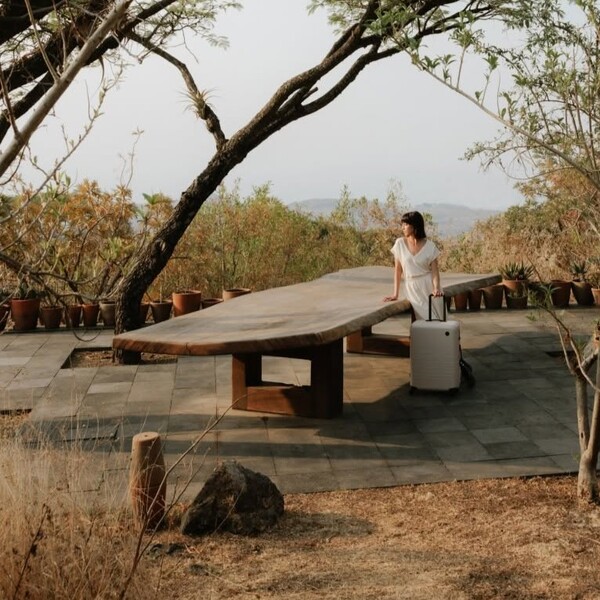
The FAQ states that “If a part of your luggage is damaged, we will ship you a replacement part, with instructions for installation.” Replacement luggage is sent only where components cannot be repaired or replaced.
No mail-in repair service is published for luggage.
Verdict
Forty-five thousand suitcases is the figure that decides this. Both brands will post a part, but only one publishes what its repair operation actually does at scale, and only one offers chargeable repair for damage that falls outside the warranty. That second route matters because airline damage is common, and Lojel will fix it for a fee rather than declining the claim and stopping there.
6. Size Range and Capacity
Luggage gets bought one piece at a time and replaced one piece at a time, so the range a brand offers decides whether the second and third purchases stay with it. Worth checking how many sizes there are, how far the largest one goes, and whether the gaps between them match the trips actually taken.
Lojel
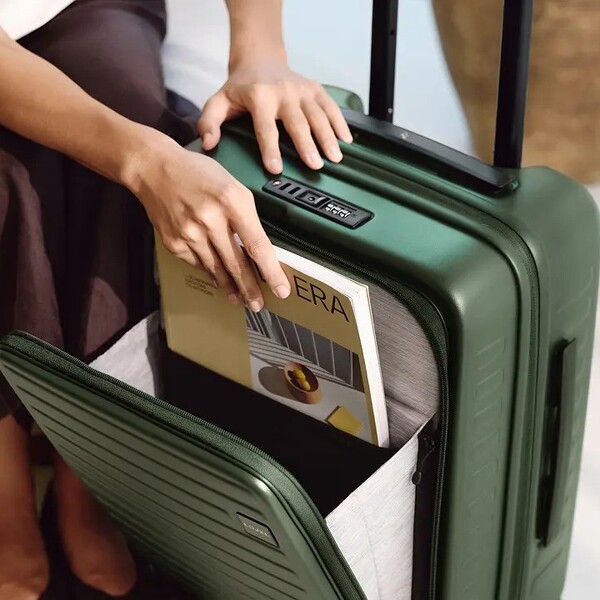
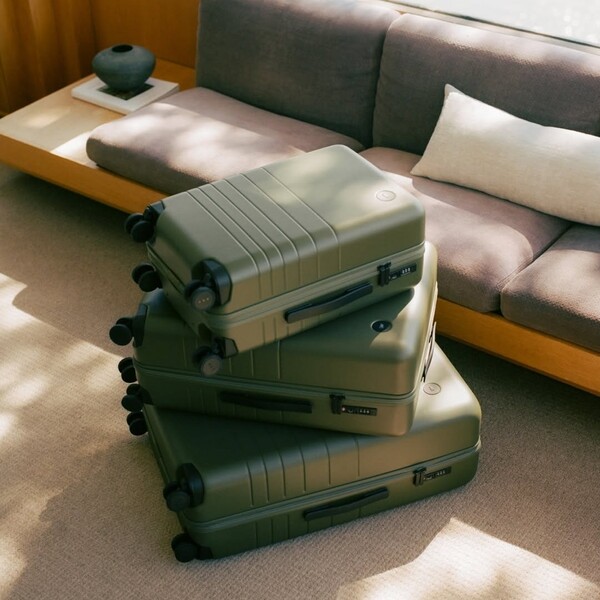
Six Cubo sizes. Small Lite at 29 to 35 liters, Small at 37 to 42, Medium at 74 to 83, Fit Lite at 89 to 101, Fit at 106 to 116, and Large at 133 to 146.
Lojel publishes a trip length for each one: 1 to 2 days for the Small Lite, 2 to 3 days for the Small, 4 to 7 days for the Medium, 7 to 10 days for the Fit Lite, 10 to 14 days for the Fit, and 14 to 21 days for the Large.
The Fit and Fit Lite are the interesting ones. Lojel calls the Fit a slender profile that’s more compact than a large suitcase while holding more than a medium, which puts two genuine sizes in the gap where most brands jump straight from one to the other. The Cubo Small also carries eight colors, the widest choice in the line. List prices run $330 to $480, with the Cubo Fit at $450.
Monos
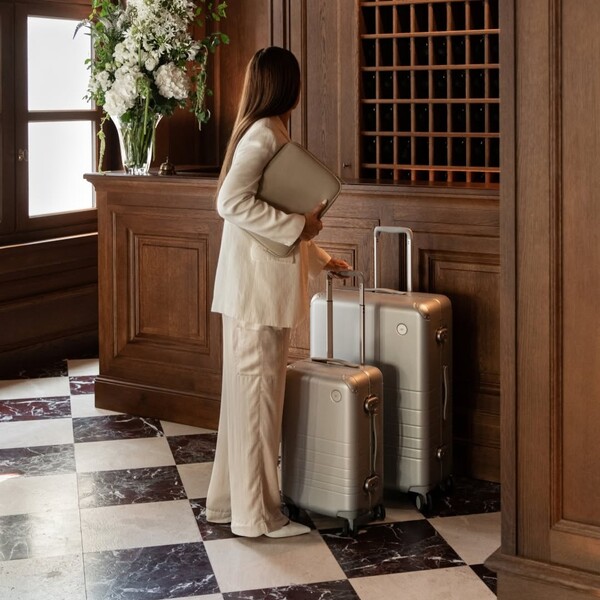
Four hard-shell sizes. Carry-On at 39.9 liters, Carry-On Plus at 45.9, Check-In Medium at 70.8, and Check-In Large at 97.3.
Monos publishes trip lengths too, at 2 to 5 days for the Carry-On, 3 to 7 for the Carry-On Plus, 7 to 18 for the Check-In Medium, and 7 to 21 for the Check-In Large. List prices run $275 to $375 for the matte colors, with Terrazzo and the glossy finishes adding $15, and Arles Blue adding $30.
Verdict
Range takes this one, and the top end is where it shows first. Lojel’s largest Cubo holds 146 liters against 97.3 for the biggest Monos, a difference of nearly fifty liters, which is the gap between a long holiday and an actual relocation.
The middle matters just as much. Six sizes against four means the steps are finer, so a ten-day trip gets the Fit Lite and a two-week trip gets the Fit, instead of a single check-in size stretched across everything from seven days to eighteen. For anyone building a set over time rather than buying it all at once, the Cubo line still has room to grow.
What Customers Are Saying About Lojel

Cubo owners write about two things more than anything else, the wheels and the opening, and they use much the same language whether the trip lasted a weekend or ten weeks.
One owner who had shortlisted the Cubo against the brands it most often gets compared to summed up the choice in a sentence.
“the best suitcase I’ve ever had. On par with the quality of monos and away, but the design is much better.”
The same reviewer had a description of the rolling that others reach for independently.
“special Japanese wheels that just glide”
Long trips are where the expansion gets tested.
“I have just completed a 10 week trip across Africa and Europe doing 11 different countries on 16 different flights and my Cubo medium Lojel has performed superbly.”
“The expansion zip worked well to fit in all my last minute souvenirs to bring home. The expansion material is thick and secure too.”
Another owner weighed the Cubo against the clamshell in Lojel’s own range before choosing.
“It was hard to choose between the clamshell and the Cubo, which I ended up buying but I’m happy with my choice, especially since it expands. This is my first hard shell suitcase, I don’t have much to compare it to! I love how smooth the wheels are.”
And the reason for the top-opening design gets recognised by people who travel a lot.
“I like how the design saves space when it’s opened. When you travel, you’d never know what your hotel room is actually like.”
What Customers Are Saying About Monos
Monos owners praise the look, the quiet wheels and the interior organisation, and several describe good experiences when a claim is approved.
“I’ve had my carry on for about 3 years now and it’s been great! One corner is damaged from being checked during an international flight, but it’s cosmetic and doesn’t affect the use of the suitcase.”
“And can I say – the QUIETEST wheels in the game.”
“Broken handle. Sent pictures and replacement sent without argument. This is why I keep buying them”
Shell durability is the theme that recurs most across the review base, raised by separate owners describing the same pattern at different mileages.
“After the initial use of the large check-in, black scuff marks appeared that were difficult to remove, even with the included Magic Eraser. In April 2025, I discovered a crack near the lock mechanism of the large check-in while cleaning it.”
“I had 2 of these luggages (one was a warranty replacement) that both got shell damaged while I was travelling. Both didn’t last more than 10 trips.”
“Then a third trip, to India from NYC, and upon arrival I noticed cracks on the long side, opposite from the handle side. Almost like someone dropped it hard. There were 4 cracks, near all four feet on that long side.”
The trial terms come up as well.
“Buyer beware! The 100 day TRIAL Monos advertises with their luggage only applies if it is NOT USED and in its original packaging! How are you supposed to TRY it?????”
Promotions and Discounts
Lojel
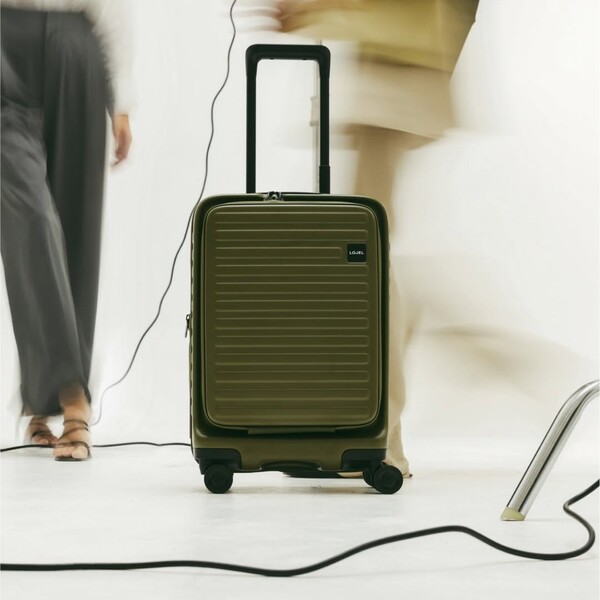
Final Call is the live promotion that covers limited-stock colorways. On the Cubo, that means Golden Ochre and Burnt Sienna, which bring the Small Lite to $280.00 from $330.00, the Small to $306.00 from $360.00, the Medium to $357.00 from $420.00, the Fit Lite to $374.00 from $440.00, and the Large to $408.00 from $480.00. No end date is published, so the stock decides how long it runs.
Newsletter signup carries a standing 10% off a first order.
Free shipping and free returns are permanent terms rather than offers. No minimum spend, and returns come with a prepaid label.
myLOJEL registration is free and stores proof of ownership against the serial number, which is what a warranty claim runs on.
Monos
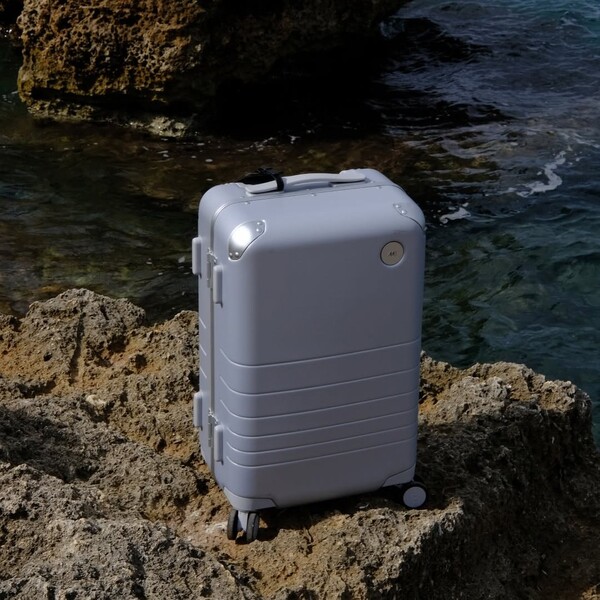
A free gift on orders over $150, chosen at checkout. Bundle savings of up to $100 on luggage, applied automatically. $20 off a set of two luggage pieces. A free luggage tag on spend over $250.
The color-based discount described above applies to the classic hard-shell line. No end dates are published for any of these.
A Wayfarer Rewards program appears in the site footer, though its terms aren’t published at any reachable page.
Verdict
For anyone buying a single suitcase, the Cubo’s offers are simpler and worth more. Free delivery with no threshold and free returns are worth roughly $25 toward a Monos return before any discount is applied, and they apply to every order rather than to orders above a spending threshold. Monos’ bundle-and-spend-threshold offers a reward for buying two or three pieces at once, which is a good deal for someone kitting out a household, and no help at all to someone buying one suitcase.
Shipping and Returns
Lojel
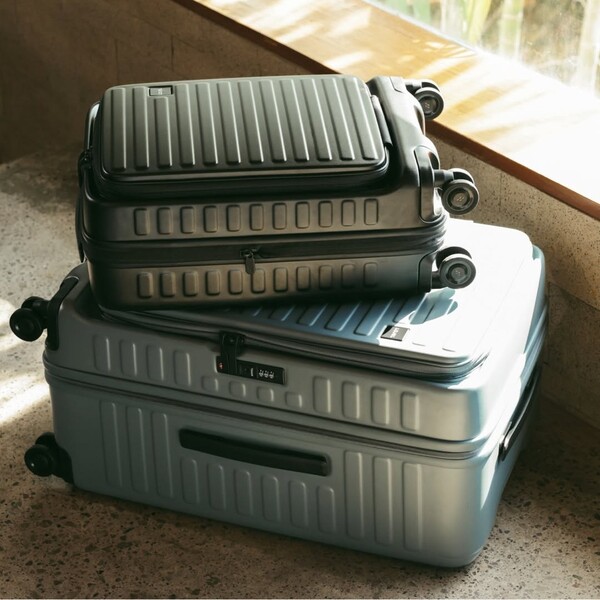
Free standard shipping on all orders to the 48 continental United States and Washington, DC, with no minimum. One business day to process, one to three days to deliver. Returns are free for 30 days on unused items, with a prepaid label supplied.
Afterpay is offered at checkout, splitting any Cubo into four payments, which works out to $105.00 for the Medium and $120.00 for the Large.
Monos
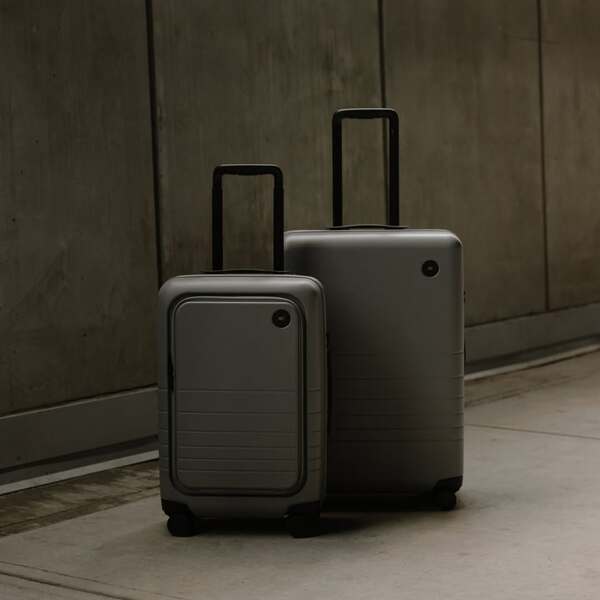
Orders over $100 get free standard shipping within the contiguous United States and Canada; orders below that threshold incur a shipping charge at checkout. Standard ground runs four to six business days, expedited three, express one to two. Returns are subject to the 100-day trial, with $25 deducted from the refund.
Verdict
Not close, on either half. Free delivery with no threshold beats free shipping over $100, one to three business days beats four to six, and a prepaid return label beats $25 off the refund. For a buyer who orders a suitcase, opens it, and decides it isn’t right, the Lojel round-trip costs nothing. And the Monos round-trip costs $25. Afterpay is there on top for anyone who’d rather spread the cost over four payments.
Who Should You Shop With?
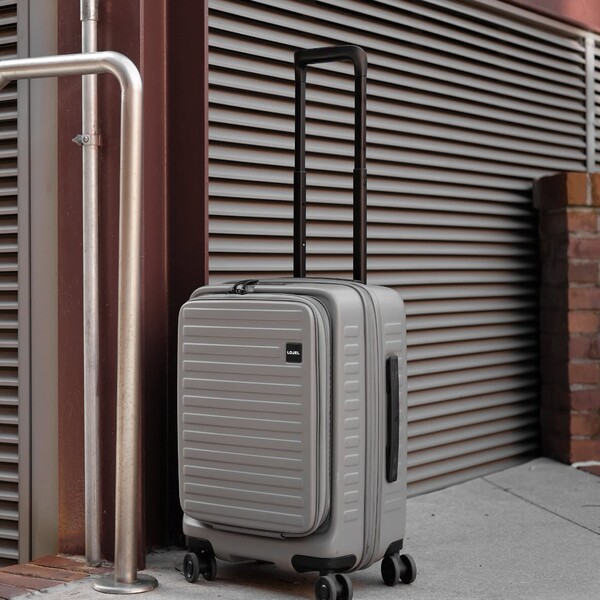
Both of these are real brands making real luggage, and either will get someone through an airport. Monos has a strong following, quiet wheels, a wide color range, and a genuine B Corp certification, and buyers who like the look tend to love it.
For instance, the Cubo is the stronger buy for most travelers, and its case builds rather than rests on any single point.
The flat-top opening solves a problem every frequent traveler recognizes, and no clamshell can answer. Expansion comes standard on all six sizes, rather than costing $50 more for four colors.
The warranty covers zippers from day one rather than requiring them to be sold back within a fortnight. There’s a repair operation behind it, with forty-five thousand suitcases rather than a parcel of parts.
Delivery and returns are both free, with no threshold or deductions. Six sizes cover the trips four can’t, and the largest Cubo holds nearly fifty liters more than the biggest case Monos makes.
For anyone who packs in small rooms, comes home heavier than they left, and expects to still own the bag in ten years, Lojel is the one to buy.
Check out other luggage and travel brands you may enjoy


Ask the community or leave a comment
WRITE A REVIEWCustomer Reviews
Leave a review