
In partnership with Prolon

The “diet” category has been overstuffed for 50 years. Intermittent fasting, keto, Whole30, the latest TikTok protocol with a hashtag and a celebrity. The reader past a certain age has tried at least three, lost some weight, gained it back, and walked away from the next pitch with a tighter skepticism. Prolon does not fit in that lineup, and the people building it have been firm about that.
Prolon is a 5-day Fasting-Mimicking Diet developed at the University of Southern California’s Longevity Institute. Its product page does not lead with the word “diet” as a marketing handle, as it is not actually a “diet” in the weight loss sense of the word. The pitch is longevity, which covers weight care, cellular renewal, metabolic reset, biological age reduction (after three monthly cycles), and visceral fat targeting with lean muscle protection. Weight loss happens, but Prolon has framed it as a byproduct of the metabolic work rather than the headline.
That distinction is the whole story. Whether a 5-day program that recommends an onboarding of three consecutive monthly cycles, followed by three to four yearly, actually delivers cellular outcomes, or whether the science is being borrowed to dress up another version of the calorie-deficit pitch, is the question this review goes after. Below is what Prolon is, what the clinical data actually shows, and whether the protocol is worth the commitment.
Table of Contents
What Is Prolon?

Prolon is a 5-day nutrition protocol developed by Dr. Valter Longo, the director of the Longevity Institute at USC and the Longevity and Cancer Program at IFOM Milan. Dr. Longo spent more than two decades studying the world’s longest-lived populations and the cellular mechanisms behind their longevity before designing the fasting-mimicking diet, which keeps the body in a biological fasting state while still allowing a structured, plant-based diet over five days.
The format is what makes the protocol distinct. A water fast strips the body of nutrition completely. A calorie-restricted diet lowers daily intake but still keeps the body in a fed metabolic state. The FMD threads the gap. It’s calibrated to keep insulin, glucose, IGF-1, and other nutrient sensing pathways and metabolic signals low enough that the body reads “fasted” at the cellular level, while delivering enough macro- and micronutrients across the five days that a user can mostly keep going about their daily lives, working, and getting through the protocol without the muscle loss and other challenges that come with a true water fast.
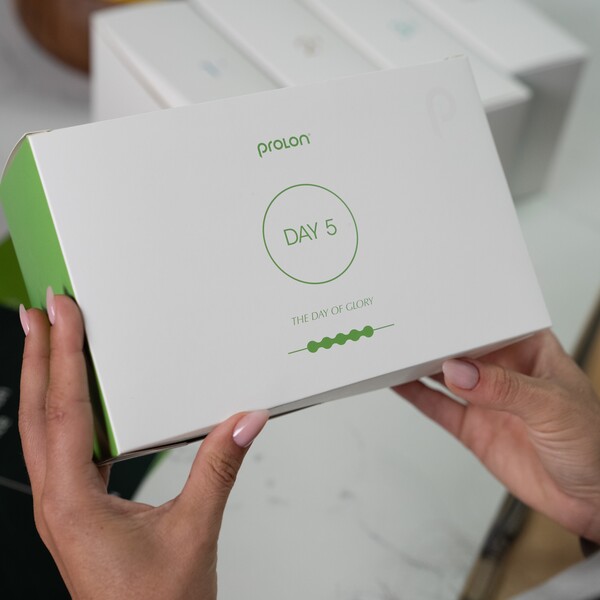
Each day of the kit is pre-portioned and walks the user through breakfast, lunch, an afternoon snack, dinner, an L-Drink (a glycerol-based hydration drink that helps to both protect muscle mass and maintain energy and electrolyte balance during the fast), and supplements. The food itself rotates through nut-based bars, vegetable soups, kale crackers, olives, herbal teas, an algal oil supplement, the proprietary NR-1 capsule with vegetable powder plus vitamins and minerals, and a chocolate crisp bar across the five days. The Next Gen version moves to certified organic, ready-to-eat soups with updated flavors and textures, designed to reduce prep time.
The clinical standard is an onboarding of three consecutive monthly cycles. That detail is the load-bearing piece of much of the peer-reviewed outcomes attached to the program. A single 5-day round produces measurable metabolic support, but the biological-age reduction, the immune support marker shifts, and the deeper skin outcomes are observed after three rounds.
The Science of the 5-Day Reset

Cellular work occurs in stages over the five days.
Day 1 is the highest-calorie day of the protocol. Even so, it delivers fewer calories than the body is used to, which begins pulling it off its normal fueling pattern. Insulin and glucose begin to drop.
By Day 2, the body shifts toward fat as its primary fuel source, and a mild ketosis sets in as the liver starts producing ketones.
Day 3 and 4: Ketones rise. Insulin drops further. The body ramps up autophagy, the cellular recycling process that clears damaged proteins, dysfunctional organelles, and the debris that accumulates inside cells across a normal year.
Until recently, autophagy activation in humans had been inferred from metabolic shifts and animal data rather than measured directly. That changed with a 2025 study led by Cedars-Sinai Medical Center and UT Health San Antonio (NCT06115551), in collaboration with L-Nutra. The researchers ran a randomized three-arm trial with 30 healthy adults aged 25 to 65 (roughly 80% female, 80% Hispanic/Latino) and used molecular assays typically reserved for pharmaceutical research to measure autophagic flux directly in immune cells. The Prolon group showed clear molecular signs of autophagy activation by Day 6, with similar shifts in the modified-formula arm, while the control group showed no change. The Cedars-Sinai principal investigator, Dr. Sara Espinoza, described the trial as one of the first to track autophagy as a real-time process in humans during a nutrition program. Prolon is the first and only nutrition program clinically proven to trigger autophagy directly in humans.
Day 5 carries the deepest autophagy phase, with the cellular renewal still going into Day 6 and 7. The transition day after the protocol returns the body to normal eating.
That five-day arc, run as a single cycle, delivers measurable metabolic support. Run for three consecutive cycles in three monthly intervals, and the data starts to compound. A 2024 paper in Nature Communications, lead-authored by Sebastian Brandhorst, Morgan Levine, and Valter Longo, pooled data from two independent randomized clinical trials and found that three FMD cycles reduced median biological age by 2.56 years across 86 participants. The biological-age measure is the KDM (Klemera–Doubal) score, a clinical-chemistry composite built on seven multi-system blood and clinical biomarkers (albumin, alkaline phosphatase, serum creatinine, C-reactive protein, HbA1c, systolic blood pressure, total cholesterol). The reduction was independent of weight loss. Subjects who didn’t lose weight still showed a decrease in biological age. Importantly, the paper also reported non-responders: 30.7% of Trial 1 participants and 21% of Trial 2 participants showed an increase in biological age across the protocol. The intervention works for the majority but not for everyone.
Visceral fat targeting is the second pillar. The MRI subset in the same Nature Communications paper (N=15) showed significant reductions in visceral adipose tissue after three FMD cycles (p=0.0017), with hepatic fat fraction dropping nearly 50% in participants with baseline hepatic steatosis. The companion comparison against the Mediterranean diet (run across the second trial) showed FMD uniquely reducing trunk fat mass as an indicator of visceral adiposity, while the Mediterranean arm did not.
Muscle protection is the third pillar, and it has its own dedicated study. A 2022 randomized controlled trial published in the European Journal of Applied Physiology (Nardon et al., PMID 35034194) compared FMD with a normal-diet control across three cycles in 24 physically active young men. Body mass dropped 2.6 kg in the FMD arm after the first cycle. Neuromuscular force production, maximal voluntary isometric contractions, and muscle volume did not change between groups throughout the protocol. The authors concluded the FMD “could be safely adopted by strength athletes without detrimental effects on force and muscle volume.” For a category where calorie-restriction diets routinely trim muscle alongside fat, that’s an important signal.
Skin and cellular renewal mark the third pillar of the three-round arc. A 2023 randomized controlled trial in the Journal of Clinical Medicine (Maloh et al., PMC10003066) ran the FMD across 45 healthy women aged 35 to 60 over 71 days (three consecutive monthly cycles). At Day 11, five days after completing the first cycle, the treatment group’s skin hydration was 25.1% above baseline, compared with 8.52% in the control group. Skin hydration in the treatment group remained significantly elevated at Day 71 (p=0.02) after the third cycle wrapped, while the control group’s skin roughness increased significantly (p=0.032) over the same window. Cellular renewal becomes visible from the outside.
The Nature Communications 2024 paper also reported an immune age signal. The lymphoid-to-myeloid ratio, a marker of immune cell composition that shifts toward more myeloid cells with age, rose significantly in FMD completers (p=0.005) but did not change in controls. The shift was also significant in participants over 40 (p=0.036), the age group most relevant to longevity intervention.
Weight Loss Results

Yes, weight comes off. The Cedars-Sinai autophagy study recorded an average weight loss of 1.7 kg (about 3.75 pounds) across a single 5-day cycle, with fasting glucose dropping by 12 to 14 mg/dL and HOMA-IR scores falling alongside. The three-cycle protocol delivers more across a 71-day window. But the framing is the part the brand has been careful about. Weight loss is a byproduct of metabolic work, not the headline.
What’s coming off is more important than how much. Most calorie-restriction diets cause weight loss as a mix of fat, water, and lean muscle, with the muscle loss most pronounced in the first weeks and a metabolic slowdown that follows. The FMD has been shown to do the opposite. The Nature Communications 2024 MRI subset showed visceral fat reduction across the protocol, the Verona muscle-force study (PMID 35034194) showed no detrimental change in muscle volume or force production, and the Mediterranean comparison data showed FMD participants maintaining muscle mass while the Mediterranean diet arm lost roughly 2 pounds of muscle and almost 5 pounds of fat-free mass across the same window.
The cardiometabolic side of the data carries its own surprise. The published Mediterranean comparison study ran 4 cycles of the FMD (20 days total) against 120 continuous days of strict Mediterranean diet adherence in overweight and hypertensive patients. The two protocols produced equivalent improvements on cardiometabolic markers (blood pressure, lipid profile, fasting glucose, and inflammatory markers), with FMD showing additional sustained reductions in insulin, HbA1c, and HOMA-IR at the 3-month follow-up that the Mediterranean arm did not. The Reactive Hyperemia Index, a marker of vascular function tied to biological age, dropped significantly in the FMD arm and stayed flat in the Mediterranean arm. The math is unusual. Four total weeks on the FMD across four monthly cycles produced what a buyer would otherwise need four months of disciplined Mediterranean eating to achieve, with extras on muscle protection and vascular function.
For someone who has been counting calories on apps and watching the scale plateau, the framing shift is the part to absorb. The numbers on the scale are a downstream signal. The visceral fat reduction, muscle protection, and vascular and metabolic improvements are the actual outputs of the protocol, and those are what the data hang on.
Who Prolon Is For

The buyer Prolon is built for is not the person who wants to drop 30 pounds for a summer wedding. The buyer is the longevity-curious adult, somewhere between 30 and 55+, who has read about cellular health and biological age and wants a clinically validated way to act on it. The protocol assumes a person who can commit five disciplined days a month for three months and who is more interested in the cellular outputs than the scale number.
Prolon is not for everyone. The brand openly publishes contraindications, which align with what a doctor would flag for any fasting-style intervention. Pregnant or breastfeeding women should skip it. People underweight or with a BMI below 18 should skip it. Anyone with diabetes (Type 1 or insulin-dependent Type 2) should consult a healthcare provider before starting (or consider offerings available via L-Nutra Health), since the metabolic shifts during the protocol can interact with medication. Anyone with a history of eating disorders, anyone on dialysis, anyone with active cancer treatment, and anyone with kidney or liver disease should clear it with their physician.
A separate point worth making, honestly. The Nature Communications 2024 paper reported a non-responder rate of 21-31% across the two pooled trials, in which biological age increased rather than decreased across the three cycles. The cellular response varies across individuals, and a single round is a reasonable way to find out where your own physiology lands before committing to the full three.
For everyone else who fits the demographic, the longevity-curious, the fasting-aware, and the person who wants clinical validation behind their next routine, the FMD is the most rigorously studied nutritional protocol on the market. The patents are real. The peer-reviewed publications are real. The clinical replication is real.
The 3-Round Protocol

Every long-form outcome in the clinical data, including the 2.56-year reduction in biological age, the immune-age signal, skin hydration retention at Day 71, and cardiometabolic equivalence with Mediterranean eating, is observed after three consecutive monthly cycles. Not one. The 3-round protocol is the protocol that the studies actually tested.
A single round of Prolon does deliver real metabolic support, however. Results have shown that insulin can drop, ketones can rise, autophagy can activate (confirmed directly in the Cedars-Sinai data by Day 6), visceral fat can begin to be targeted, and skin hydration jumps measurably by Day 11. But the biological age reduction arc only completes across three rounds. The first round seeds the work, the second deepens it, and the third locks the cellular signals into place. Buyers who run one cycle and stop are getting a partial result.
The pricing reflects this. The Prolon 5-Day FMD retails at $205 a round, with subscribe-and-save pricing at $175 a round when committing to a multi-cycle delivery schedule. The Next Gen version, which uses certified organic soups and ready-to-eat convenience, retails at $255 and starts at $215 with subscribe-and-save. The 3-round protocol, three boxes delivered across three consecutive months, followed by 3-4 cycles per year, is the version Prolon’s own clinical data points to. The subscribe-and-save structure is built around this protocol, which is why the brand recommends the subscription over a one-time order.
The Verdict
Prolon works differently from anything else on the market. It is the only nutrition program patented for longevity through cellular rejuvenation and the only one clinically proven to trigger autophagy directly in humans, confirmed by molecular assay in the 2025 Cedars-Sinai and UT Health San Antonio trial. Its clinical trial portfolio spans 47 studies across 18 leading research institutions, including USC, Stanford, Cedars-Sinai, and Mayo Clinic. The peer-reviewed publications span Nature Communications, the Journal of Clinical Medicine, the European Journal of Applied Physiology, and others. The patent count is north of 200.
A note on independence. Most of the published FMD research has been funded by L-Nutra, the company that produces Prolon, and Dr. Valter Longo is both the founding scientist and a long-standing scientific advisor. The conflict-of-interest disclosures are openly published in every paper, which is the standard expected in clinical research, but readers should weigh the data with that in mind. The replication across multiple independent institutions (Cedars-Sinai, UT Health San Antonio, Yale, University of Verona) and across peer-reviewed publications is what the case ultimately rests on.
For a buyer who fits the demographic, longevity-curious, willing to commit five days a month for three months to begin (followed by three-four times a year after that),, more interested in cellular outcomes than scale numbers, the 3-round protocol is the recommendation the science supports. It is not a weight-loss program or a quick-fix protocol. It is the only nutritional intervention built to deliver cellular renewal on a defined clinical schedule.
The single round is the entry point for readers not ready for the full commitment. One round activates the cellular process, and can still deliver its own benefits, but three rounds compound it.
For most longevity-focused adults, asking whether the 5-Day FMD is worth the time and cost, the answer is yes, and the version worth doing is the 3-round protocol, which the data actually validate. The subscribe-and-save bundle of three consecutive rounds is the protocol the clinical data supports.
Looking for more reliable ways to shed a few pounds? Then check out these trusted brands below:




Ask the community or leave a comment
WRITE A REVIEWCustomer Reviews
Leave a review